
Divorce Preparation Guide for Stay-at-Home Moms: What to Do First

Updated: Sep 8
You've spent years investing in your family. Here's how to invest in your future.

If you're a stay-at-home mom facing divorce—whether it's something you've been quietly considering or something your spouse just dropped on you—the fear can be overwhelming. Financial independence. Re-entering the workforce. Childcare on your own. Legal rights you're not sure you have. It's a lot.
Here's what I want you to know before anything else: your situation is more common than you think, and you have more options than you realize. But preparation is everything. The stay-at-home moms who walk through divorce feeling empowered and clear are the ones who started preparing early—before emotions were running the show.
This guide walks you through exactly what to do, in the order that matters most.
Subscribe to The Divorce Planner newsletter and get divorce prep tips and tools delivered right to your inbox!
Start Here: The Mindset That Changes Everything
Think of yourself as the CEO of your own transition. You are not a passive participant in this process. You are a decision-maker navigating a complex life change—and like any good CEO, your job is to understand your situation completely before you make any moves.
Divorce has an emotional side and a business side. You have to address both. The emotional side is real and valid and needs space. But the business side—the financial picture, the legal strategy, the practical preparation—cannot wait for you to feel ready. You prepare while you're going through it. That's how you protect yourself.
Step 1: Get Your Financial Picture Completely Clear
This is the most important thing you can do right now, and it's the thing most stay-at-home moms put off because it feels overwhelming. Don't.
As a stay-at-home mom, you may have been largely removed from the day-to-day management of household finances. That changes now. Understanding what you have, what you owe, and what your life actually costs is the foundation for every decision that follows.
What to Gather:
Financial documents (bank statements, tax returns from the last three years, pay stubs if applicable)
Property deeds and mortgage documents
Debts and liabilities (credit cards, loans, car payments)
Prenuptial or post-nuptial agreements
Any court documents related to the divorce or custody matters
Retirement account statements (401k, IRA, pension plans — yours AND your spouse's)
Insurance policies (health, life, property)
A complete list of your assets (property, vehicles, jewelry, art, business interests, collectibles)
An accurate accounting of your monthly household expenses
Start with what you can easily access and work outward from there. Once you announce divorce, access to shared accounts and documents can become complicated or restricted. This is your window. Use it.

The Get Organized 2-Pack ($37) walks you through every document category with a complete checklist and asset log so nothing falls through the cracks.
Step 2: Understand Your Financial Reality
Gathering documents is step one. Understanding what they mean for your post-divorce life is step two.
As a stay-at-home mom, you need to know two numbers before you negotiate anything:
Your marital standard of living — what your household has actually cost to run as a married couple. This is the baseline for spousal support negotiations.
Your post-divorce budget — what your life will actually cost on your own. Housing, utilities, food, childcare, healthcare, transportation, insurance, debt payments. The real number, not a guess.
Most people are off by hundreds or thousands of dollars when they estimate. And when you negotiate based on a wrong number, you walk away with a settlement that doesn't actually cover your life.

The Monthly Budget Calculator ($37) is CDFA-approved and walks you through every expense category — including changes you might not think about, like healthcare costs that can increase significantly after divorce when you're no longer on a spouse's plan.
Step 3: Know Your Legal Rights as a Stay-at-Home Mom
This is where many stay-at-home moms feel most vulnerable — and where preparation makes the biggest difference.
Here's what you need to understand:
Your contribution to the marriage has financial value. Years of childcare, household management, and supporting your spouse's career are recognized contributions in divorce law. You are not starting from zero.
Spousal support exists for situations like yours. Alimony is designed to address significant income disparity, which is exactly the situation when one spouse has been out of the workforce to raise children. How much, how long, and what form it takes varies by state, but don't assume you won't receive it or that it will be minimal.
You may be entitled to a portion of your spouse's retirement accounts. This is one of the most commonly overlooked assets in divorce. A Qualified Domestic Relations Order (QDRO) allows retirement benefits to be divided without early withdrawal penalties. Don't trade this away without understanding what it's actually worth.
Child support is separate from spousal support. If you have children, child support is calculated based on both parents' incomes and the custody arrangement — not based on what you earn as a stay-at-home mom.
You'll want to consult with a family law attorney to get specific answers about your situation. Get at least two attorney consultations before you decide who to hire. Some offer free consultations, so always ask first.
Be Prepared For Consultations

Before any meeting, download the 24 Questions to Ask a Divorce Attorney or Mediator so you walk in with a framework for the questions that actually matter.
Step 4: Address Retirement Accounts Before You Settle
This section deserves its own step because it's where stay-at-home moms most commonly leave money on the table.
If your spouse has retirement accounts — 401k, pension, IRA — those accounts accumulated during the marriage are typically considered marital assets, regardless of whose name they're in. You may be entitled to a significant portion.
Here's where people make the mistake: retirement accounts feel abstract. The cash, the house, the car — those feel real. So people trade away retirement assets for things that feel more immediate, without understanding what they're actually giving up.
A retirement account your spouse has been contributing to for twenty years can be worth more than the house. Don't make decisions about it without running the numbers first.
A Certified Divorce Financial Analyst (CDFA) can show you the long-term value of every asset on the table — including retirement accounts — so you know exactly what you're keeping and what you're giving up before you agree to anything.
Step 5: Plan for Childcare
As a stay-at-home mom, you've been your children's primary caregiver. Divorce can change your day-to-day realities quickly.
Start mapping out what childcare will look like under different custody arrangements. Research costs for childcare, after-school programs, and summer care in your area. These costs should be part of your settlement negotiations, not something you figure out after the fact.
Think through your typical week in detail: school drop-offs, pickups, activities, medical appointments, work commitments if you're re-entering the workforce. Where are the gaps? Where would you need coverage? Finding those gaps now gives you time to plan before they become crises.
PRO TIP: Your pediatrician is an underutilized resource during this process. They see your kids regularly, know their baseline, and can flag behavioral changes early. Don't underestimate how helpful that outside perspective can be.
Step 6: Plan Your Return to the Workforce
This is one of the biggest fears stay-at-home moms face, and it's worth addressing head-on.
First: your skills didn't disappear while you were raising children. Project management, logistics, budgeting, scheduling, negotiation, childcare coordination — these are real, transferable skills. Don't undersell them.
Start by updating your resume. Include any volunteer work, committee roles, or projects you managed during your time at home. Consider whether additional training or certifications would strengthen your position in the workforce. Reach out to former colleagues. Reconnect with professional networks. Even informal conversations can open doors.
Getting clarity on your earning potential also matters for your legal strategy. Your attorney needs to know what you can realistically earn when negotiating spousal support and child support. Get ahead of that conversation by researching salary ranges in your field before your first legal consultation.
PRO TIP: Think about income you could generate starting now, before the divorce is finalized. Freelance work, consulting, or part-time positions in your field all help establish your earning trajectory and reduce financial anxiety during the process.
Step 7: Protect Your Emotional Health
I've left this for later in the guide not because it's less important but because the financial and legal steps above need to happen regardless of how you're feeling. The emotional work should run parallel, not after.
Divorce is a grief process. Even if you're the one who wants out, you're mourning the life you thought you'd have, the family structure you built, the future you planned. That grief is real and it deserves space.
What it doesn't deserve is a seat at the negotiating table. When grief, fear, or guilt are driving your financial decisions, you make choices you'll regret. The goal is to feel your feelings in the right spaces — therapy, coaching, trusted friends, journaling, exercise — so they don't leak into the business decisions.
Build your support system intentionally:
A therapist for the emotional processing and patterns
A divorce coach for strategic preparation and action (that's what I help with!)
A trusted friend or two who can listen without judgment
A support group if you want community with people who understand

The Divorce Planner's free gratitude journal is a simple daily practice that builds resilience during one of the most stressful periods of your life. It takes five minutes and it works.
Step 8: Build Your Divorce Team
As a stay-at-home mom, your financial situation is complex enough that you need the right professionals in your corner. Here's who belongs on your team:
A family law attorney who understands your specific situation — income disparity, custody, spousal support. Don't hire the first one you meet.
A Certified Divorce Financial Analyst (CDFA) if your situation involves retirement accounts, significant assets, real estate, or complex income structures. A CDFA looks at the long-term financial implications of every decision — things your attorney may not be focused on.
A divorce coach to help you prepare strategically, stay organized, and make decisions from clarity rather than fear.
A therapist to support you emotionally through the process.
Want Expert Financial Guidance?
Working with a CDFA (Certified Divorce Financial Analyst) can help you understand the long-term implications of different settlement scenarios and protect your financial future.

My Divorce Prep Coaching PLUS CDFA Guidance Package ($2,750) combines 1:1 divorce prep coaching with comprehensive financial analysis from Certified Divorce Financial Analysts Josephti Cruz and Whitney Light at Cover Your Assets Divorce. Together we help you understand your complete financial picture, know the long-term value of every asset including retirement accounts, and build a settlement strategy that actually works for your life.
You have been holding your family together for years. You know how to manage complexity, prioritize competing demands, and keep things running under pressure. Those skills don't disappear in divorce — they're exactly what you need right now.
Prepare strategically. Build your team. Know your numbers. And make decisions from a place of clarity, not fear.
This is just a chapter. What comes next is yours to write.
Keep Reading:
Ready to Start Preparing?

Sign up for my free 4-email divorce prep series. I walk you through exactly what to do emotionally, financially, administratively, and practically— in four emails so you can move forward with confidence and clarity.

Not sure where to start?
Book a free 15-minute consultation with me and we'll talk through where you are and what makes sense for your situation.
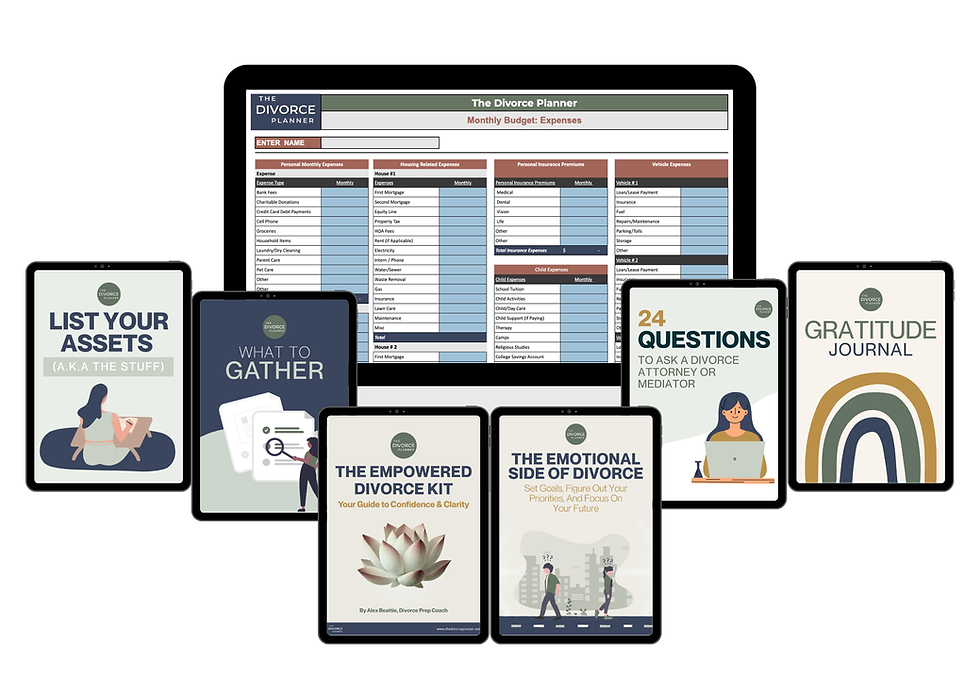
Want a complete divorce preparation system?
The Divorce Prep Bundle gives you everything: document checklists, the monthly budget calculator, asset logs, spreadsheets, and step-by-step guidance to walk into every conversation prepared.
About Me | ALEX BEATTIE
Divorce Preparation Coach & Author
Alex Beattie is the founder of The Divorce Planner, host of The Divorce Planner Podcast, and author of the upcoming The Divorce Planner: 8 Weeks to Get Organized, Find Clarity, and Become Your Own Best Advocate (Jossey-Bass/Wiley, 2027). Learn more here.


